Nov 2024
Sentverse
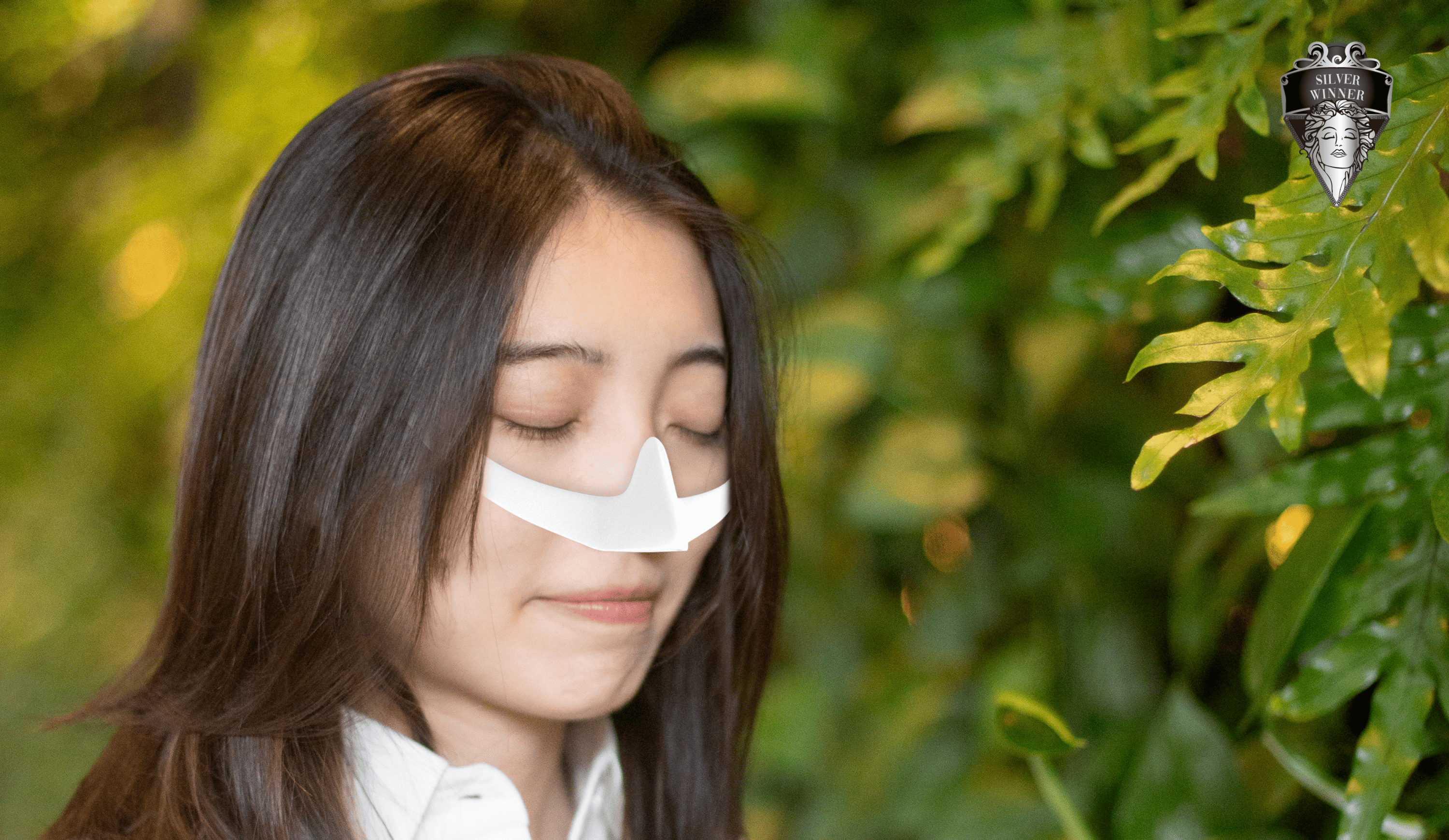
Sentverse is a wearable olfactory communication system for capturing, sending, and receiving scent across distance. It combines a face-worn device with a companion app so users can record odors from real environments, share them with others, and replay them through low-power olfactory stimulation.
Why Scent
What remote communication still cannot send is smell. People can describe a room, a flower, or a meal, yet the scent itself cannot travel with the message. Sentverse was designed around that missing sensory channel.
The gap matters because smell is closely tied to recollection and emotional response. A transmitted scent carries memory and social presence, not just information.
Research for Sentverse included 45 survey responses, 4 semi-structured interviews, and a 132-card affinity map. The interviews brought in two neurology and medical perspectives, one engineering perspective, and one media perspective. Together they pointed to three recurring requirements: the experience had to feel meaningful in communication, the wearable had to stay compact and comfortable on the face, and any stimulation method had to prioritize safety and perceptual clarity.
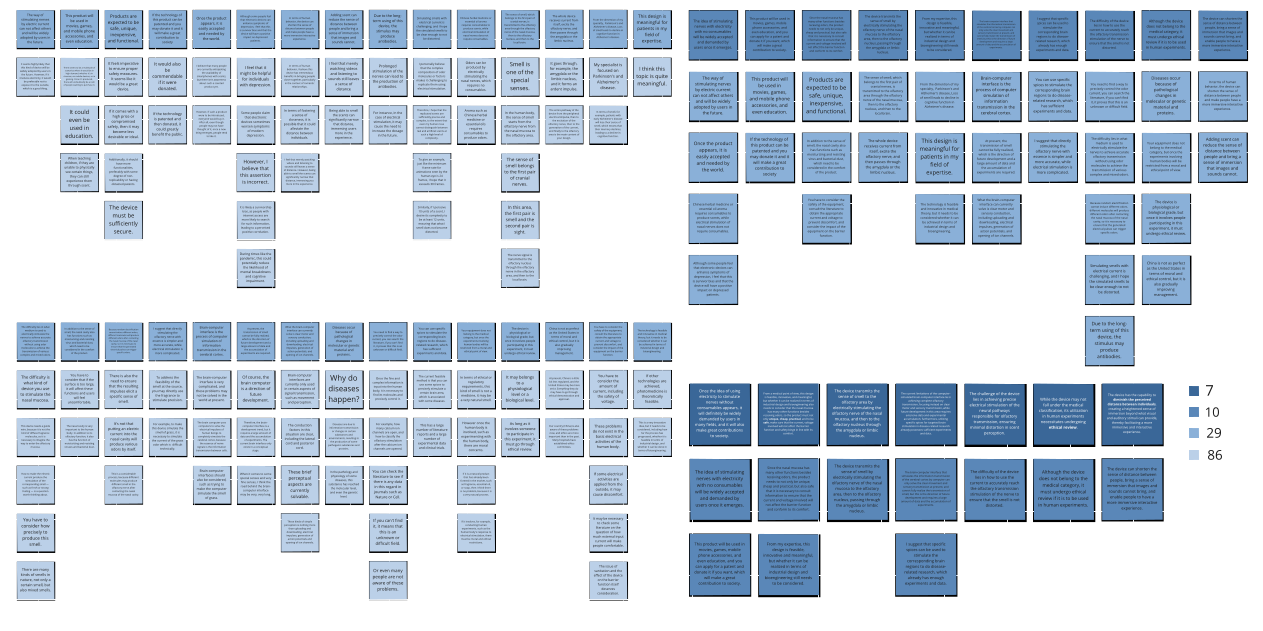
Research synthesis. Interview and survey insights were clustered into product requirements, opportunities, and technical constraints.
Olfactory Perception
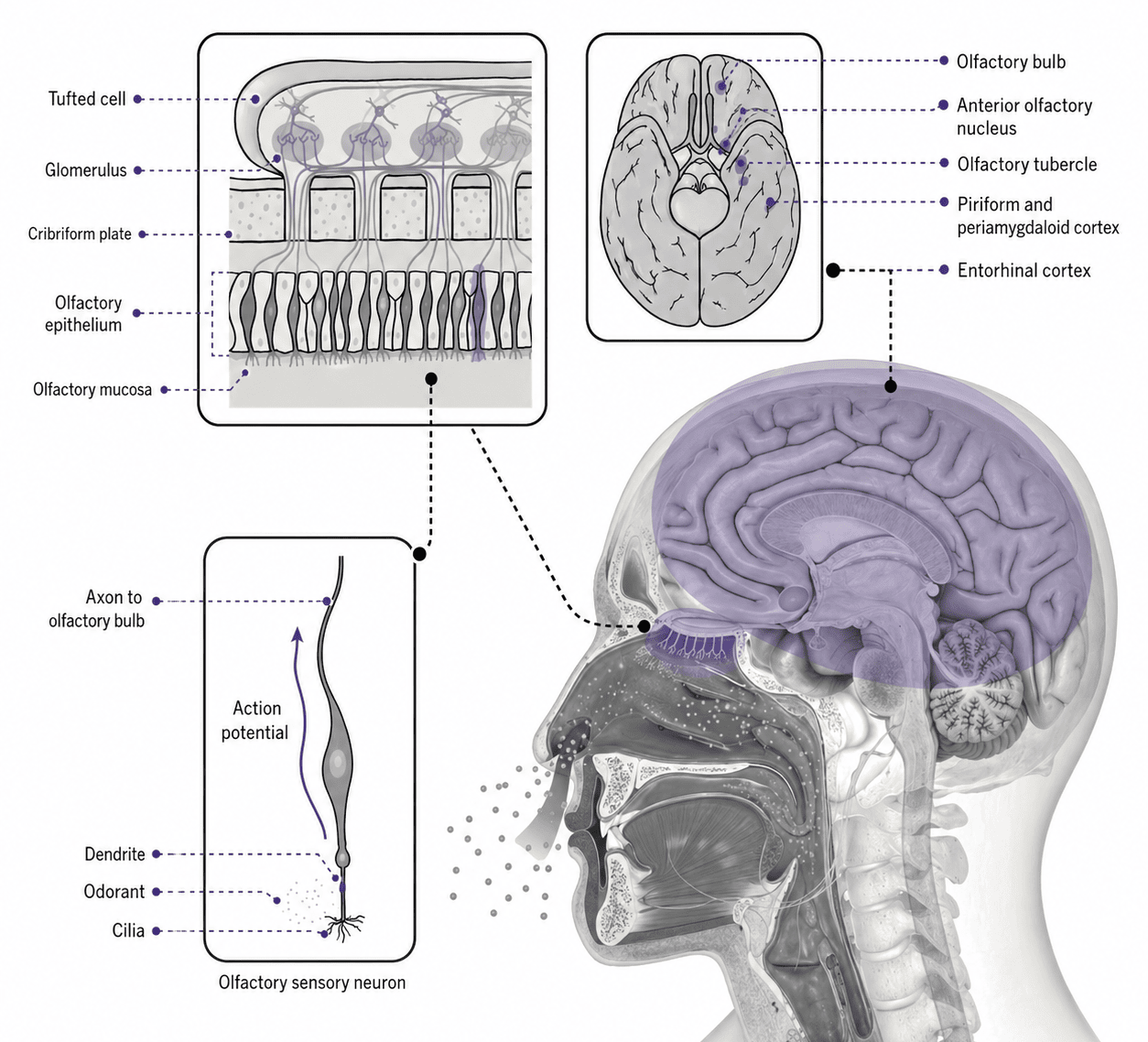
Smell begins in the olfactory epithelium, where odor molecules interact with olfactory sensory neurons and trigger electrical activity. That signal travels through the olfactory bulb and forward into regions associated with memory and emotion.
This pathway is what makes olfaction so central to recall and affect. Rather than treating scent as decoration, Sentverse takes olfactory perception itself as the design focus and asks how a digital system could capture, transmit, and replay smell as a communicative experience.
Technology Comparison
Two playback methods were compared before settling on a direction. Aroma cartridges release prepared scents, but every scent needs a matching formula, refills take space, and the library stays limited to what has been formulated. Electrical stimulation removes stored scent materials and could shrink the wearable, at the cost of being experimental and needing per-person calibration and safety testing. The project takes electrical stimulation as its speculative direction without claiming technical readiness, so the rest of the work focuses on the interaction model and product form.
System Design
The friction was never posting content. People already share photos of a meal, but the smell cannot travel with the post. The system therefore splits across a wearable device and a mobile app. On the capture side, an odor source is sensed, translated into a digital record, and routed to the app through Bluetooth.
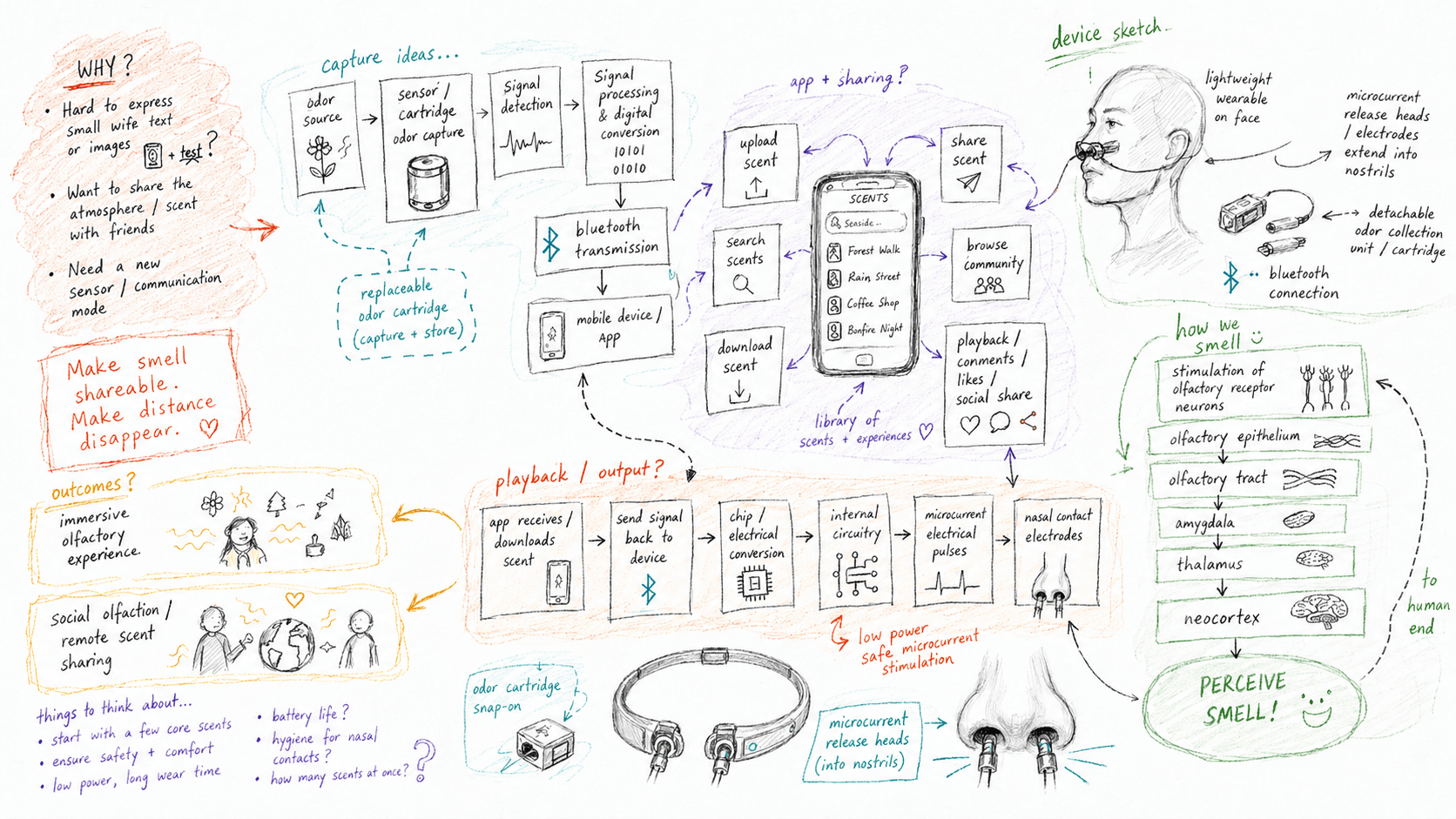
On playback, a selected scent file returns to the device, where the signal is converted into low-power electrical pulses delivered through nasal contact electrodes. Here, capture, transmission, playback, and perception are treated as one continuous system rather than separate features.
Wearable Device
The wearable was developed as a face-following form that could support odor capture, signal delivery, and comfortable contact in one structure. The design needed to stay lightweight on the face while making room for the scent sensor, detachable collection unit, battery, chip, Bluetooth control, and microcurrent release heads.
Form directions were scored on six criteria, from weight distribution and one-hand removal to nose clearance, component volume, social acceptability, and off-face capture. Early concepts placed most of the hardware near the center of the face and felt front-heavy, so the battery and electronics moved toward the cheek and ear to spread the load. The sampling module detaches from the frame so it can be brought close to a drink or an object without moving the entire wearable.
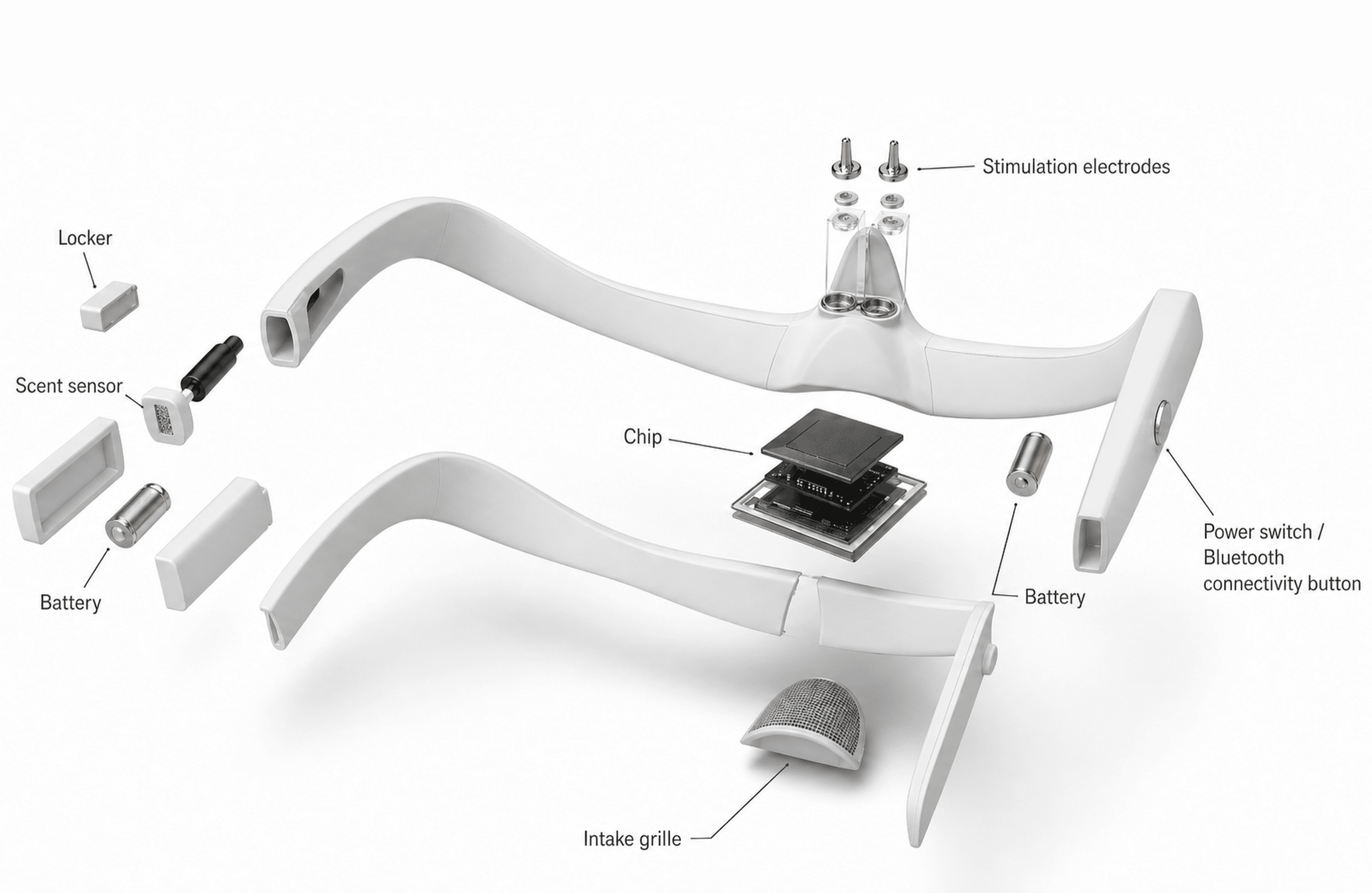
Exploded View
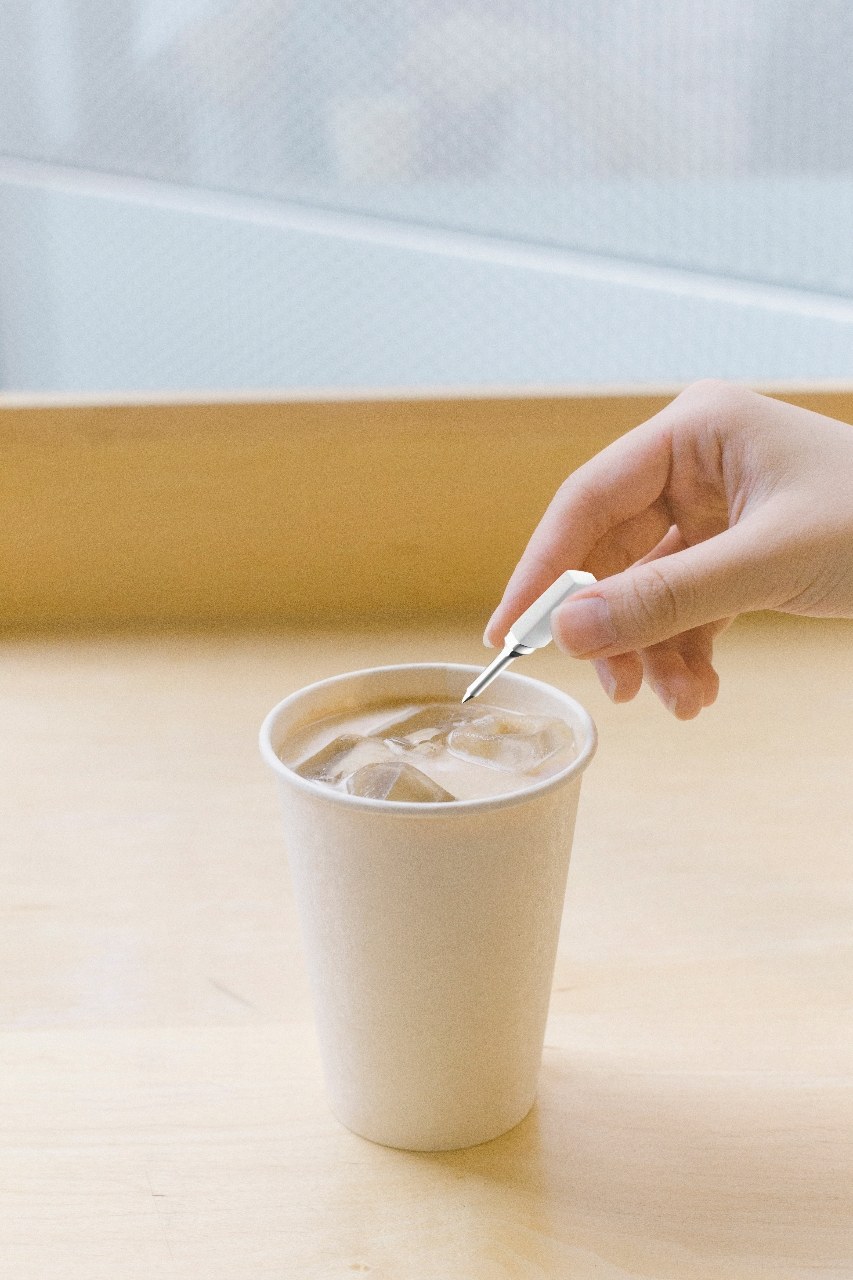
Drink Sampling
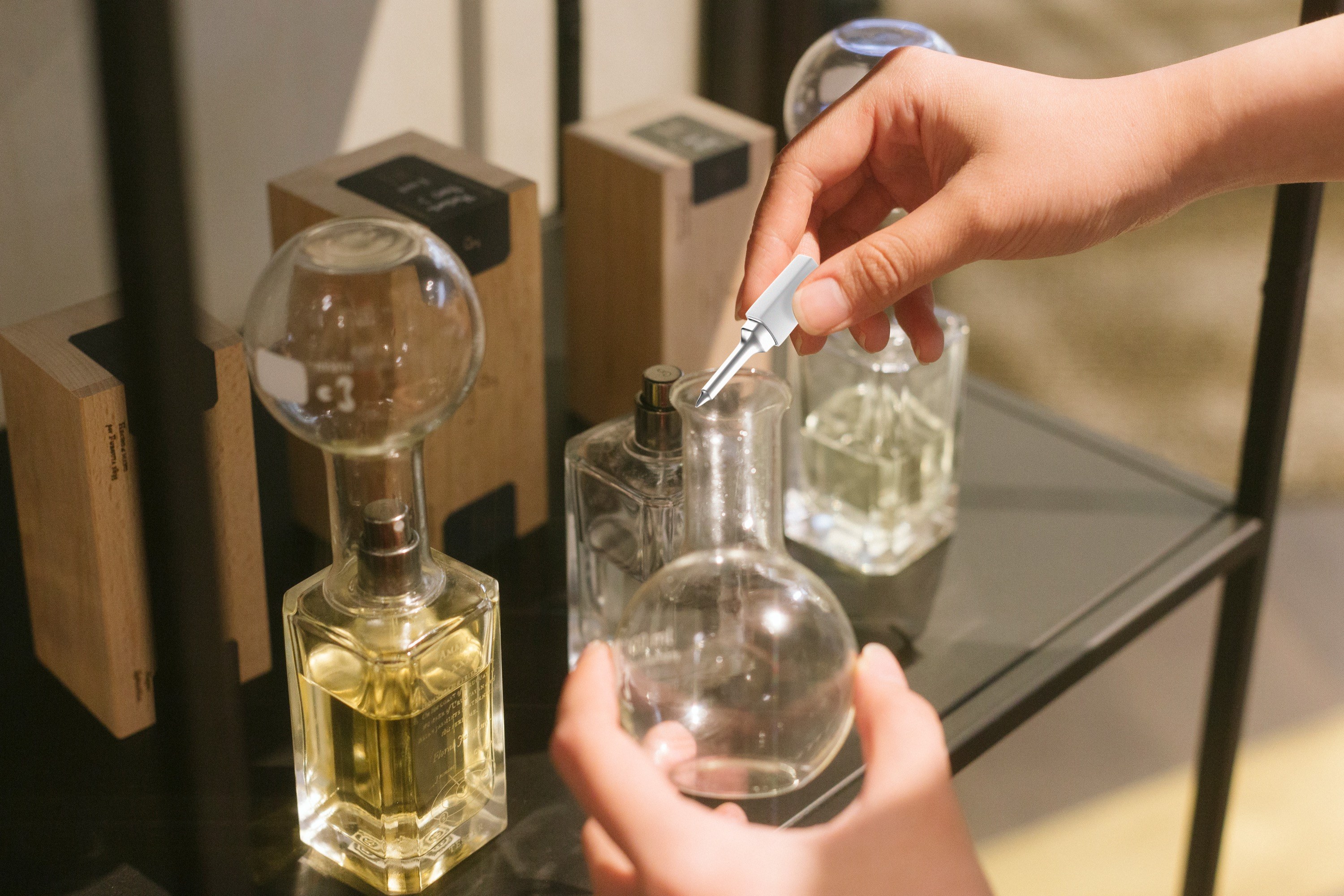
Object Sampling
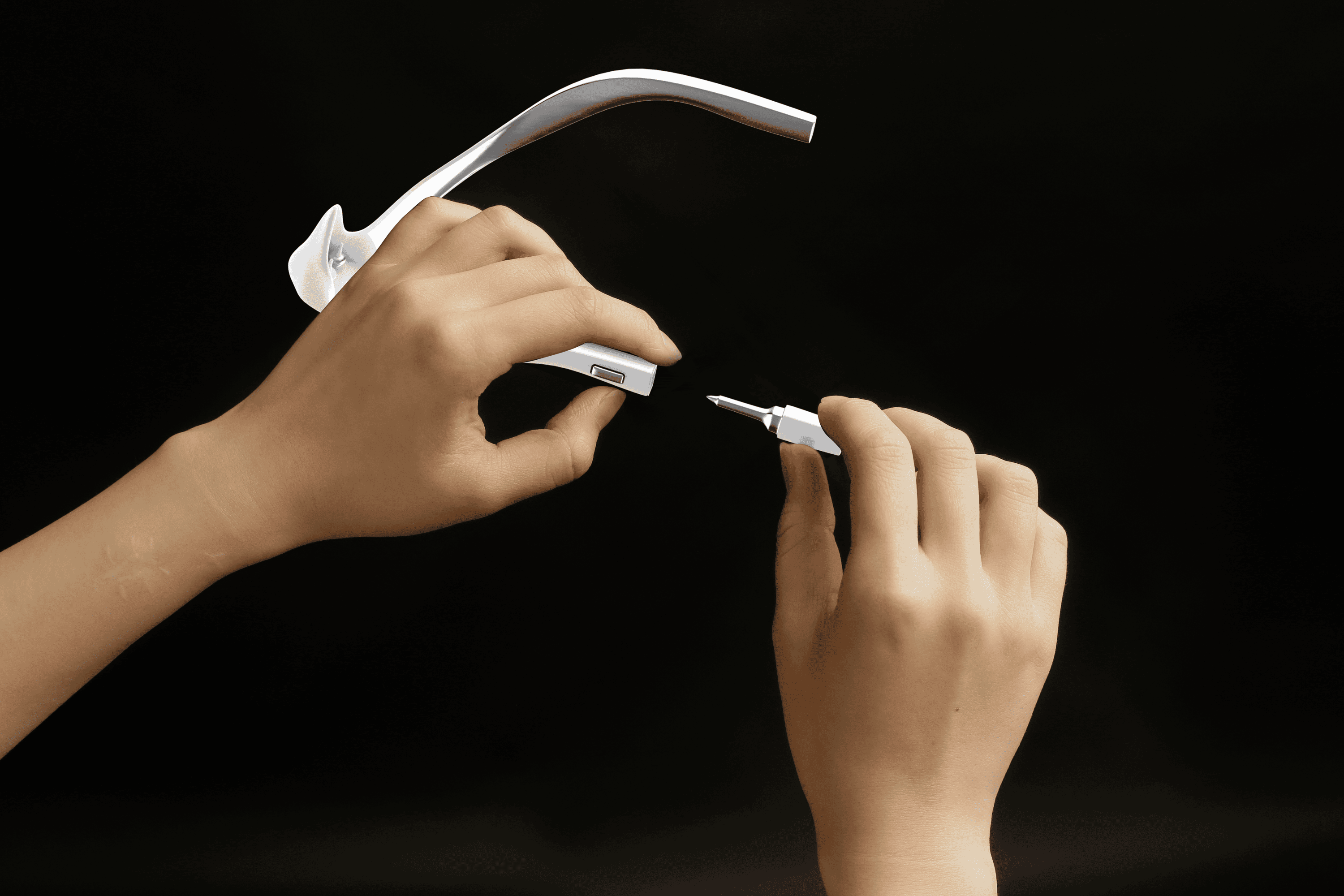
Device Detail
Integrated Experience
Together, the wearable and the app frame smell as a shareable medium rather than a private, local sensation. The system supports capturing a scent from an environment, sending it to another person, and receiving it back as an interactive olfactory experience.
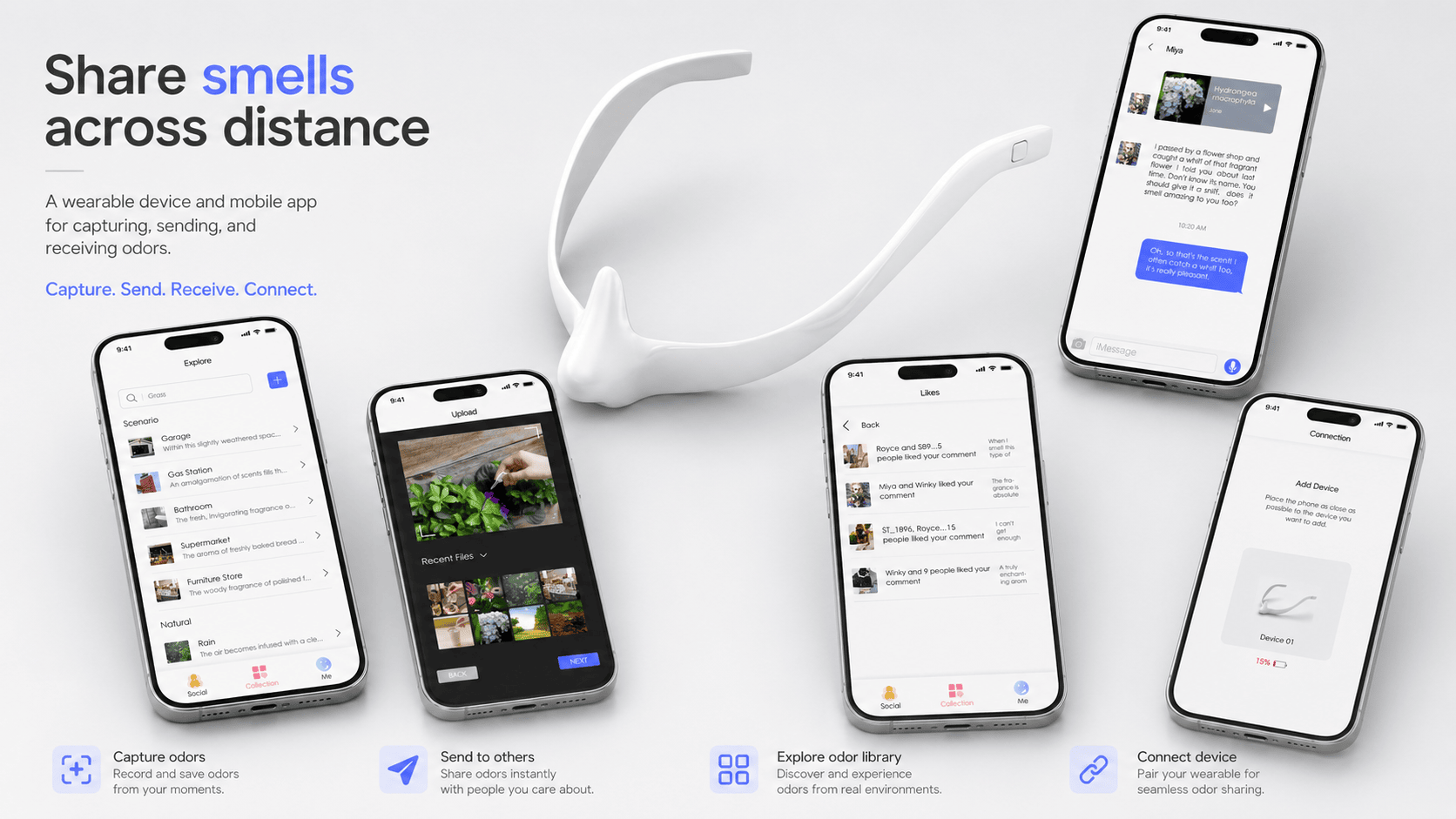
The app stores each recording with a photo, note, and location, supports one-to-one sending, keeps a shared scent library organized by place, and pairs the wearable over Bluetooth for playback and transfer.
Outcome and Limitations
The finished concept covers the system flow, wearable form, component layout, and a clickable mobile prototype, and it received a Silver Award in Wearable Technologies at the Muse Design Awards. The work did not validate scent sensing or nasal stimulation. Further development would need hardware prototyping, safety review, and controlled user testing.