2026
LURK Werewolf: Evaluating Linguistic Bias in Large Language Models
Abstract
LURK Werewolf is a game framework for testing whether LLM agents respond to meaning or to wording. Instead of letting agents speak in free-form text from the start, the system asks them to commit to logic predicates first and turns those predicates into language afterward. That split makes it possible to keep content fixed and change only the surface form. In 7-player Werewolf games, moving from predicates to natural language changed 52.6% of later decisions. A follow-up study on formality did not show a robust behavioral shift, which helps narrow down where the bias appears.
Question
Werewolf is a good place to study language because every round depends on persuasion. Players speak, judge credibility, vote, and use hidden role abilities. If wording alone can change those steps, the game makes it visible quickly.
Most LLM game frameworks cannot separate style from content. Once agents produce free-form dialogue, a stronger idea and a cleaner sentence arrive together. LURK Werewolf was built to pull those apart and test what language is doing on its own.
Method
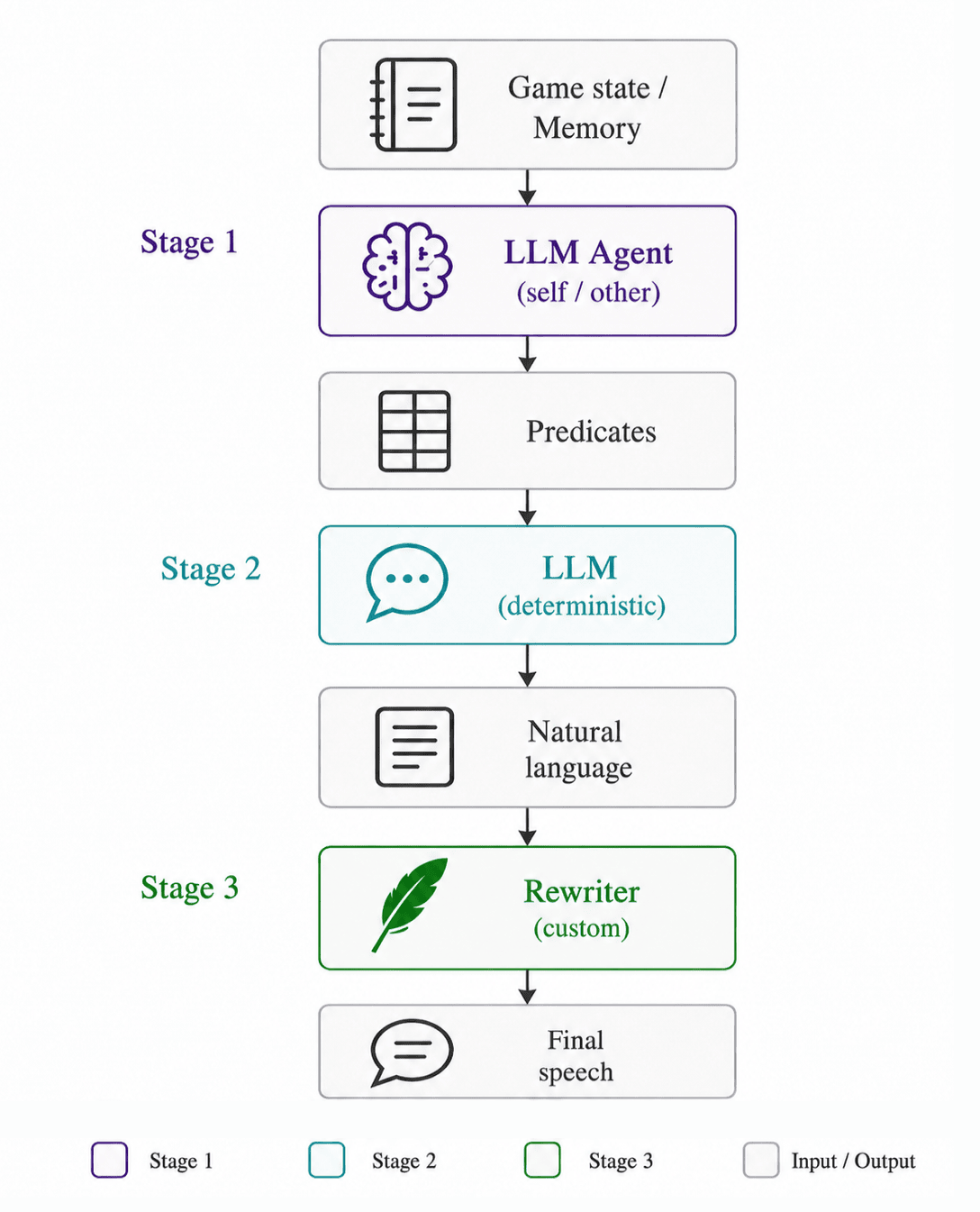
Three-stage pipeline. Each turn begins as a predicate, then becomes fixed natural language. A final rewrite step can change phrasing while keeping the underlying content the same.
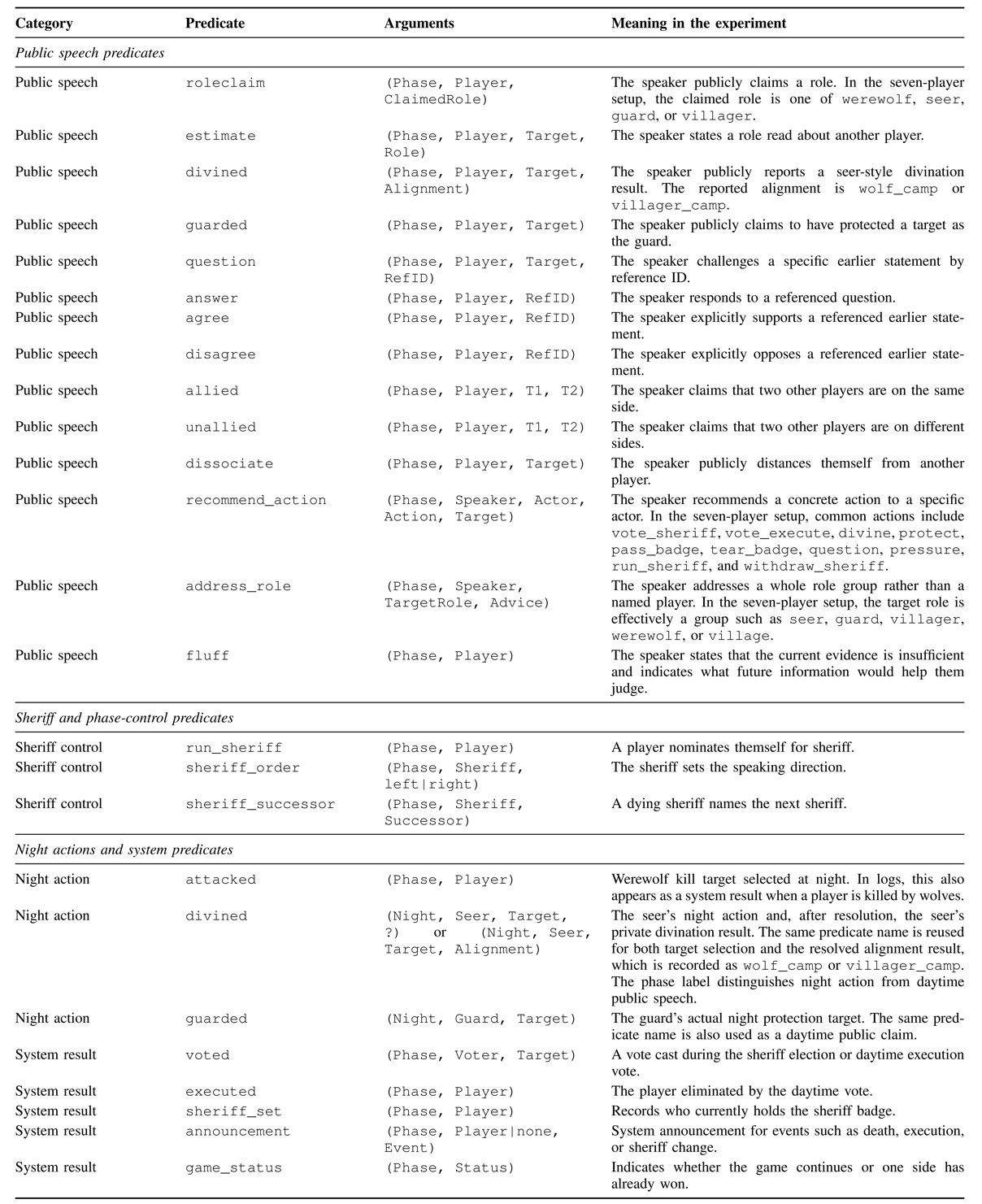
Predicate inventory. Public speech, sheriff control, night actions, and system results are all mapped into a fixed predicate set before they are turned into text.
Every speech starts as a predicate from a 34-item vocabulary covering public discussion, sheriff procedures, night actions, and system events. A complete game can be played in predicates alone. A second model with deterministic decoding then turns each predicate into the same baseline sentence every time, and an optional rewrite stage varies one linguistic feature while the predicate stays fixed, so any behavioral difference between conditions traces back to wording rather than content.
Evaluation Method
Two independently generated games drift apart after a few choices, so direct comparison fails. LURK saves a checkpoint at the start of each discussion phase and replays the identical game state under a different language condition. The framework then counts how many later skill targets, votes, and reliability ratings changed between the branches.
Findings
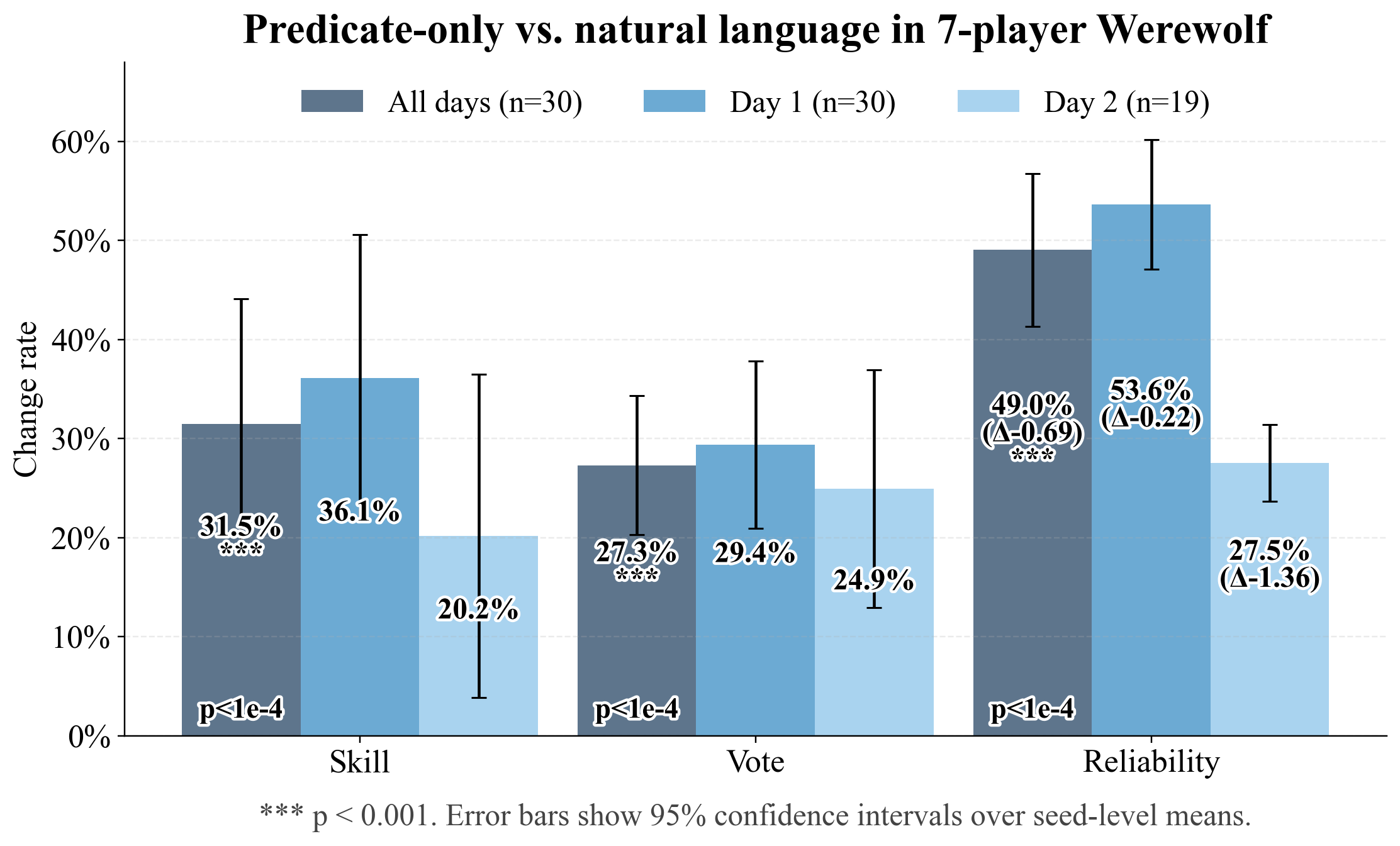
Natural language changes behavior. In 7-player games, switching from predicates to text changed 52.6% of later decisions, with the largest shift in reliability judgments.
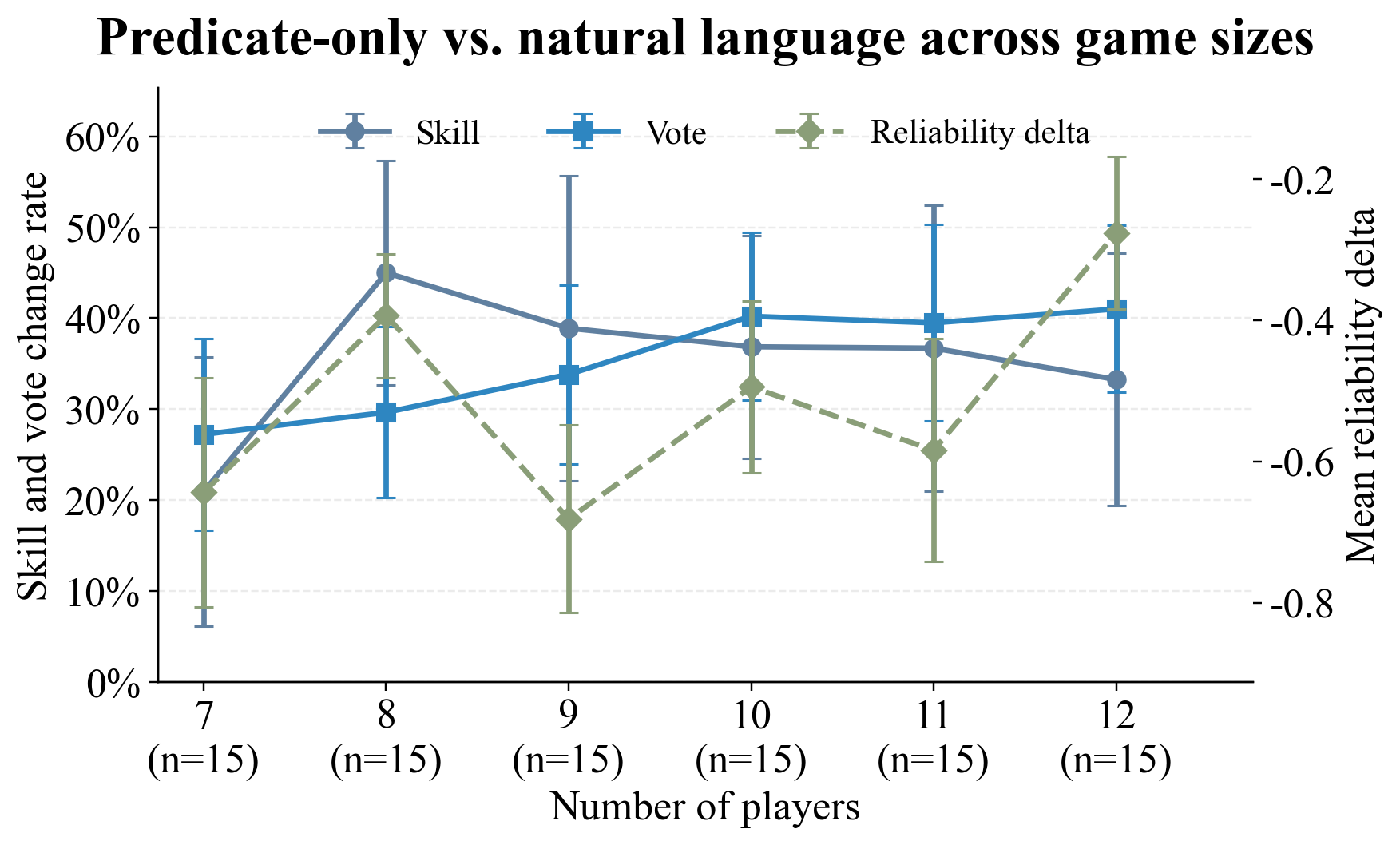
The effect scales. The gap stays visible from 7 to 12 players instead of disappearing outside the standard 7-player setup.
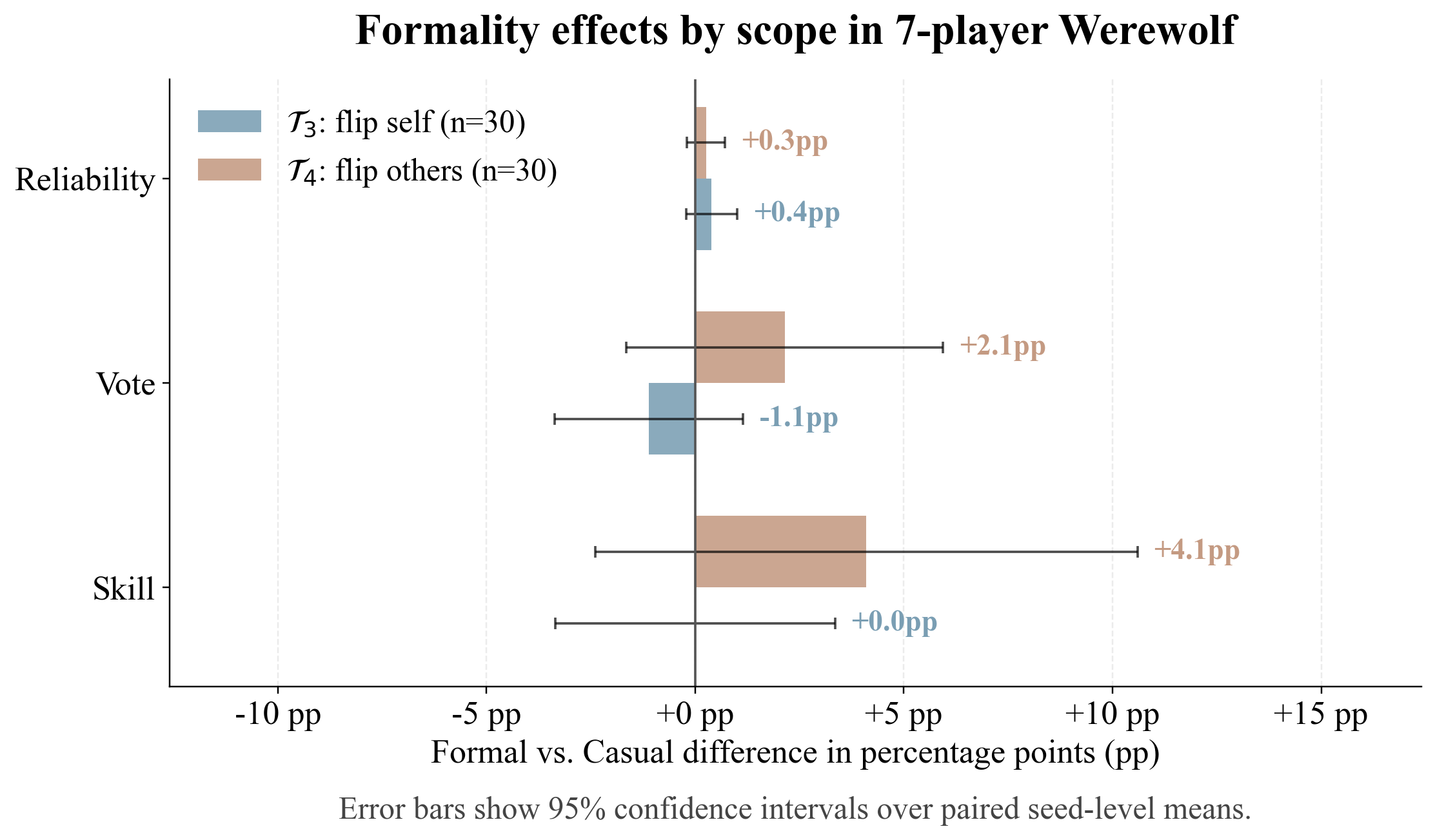
Not every style shift matters equally. Rewriting speeches to be formal or casual across 1,635 replayed phases produced measurable differences in the text itself, but no stable behavioral effect.
Trust moved most. 49% of reliability judgments shifted, and average trust dropped once agents spoke in prose. The shift was uneven across roles. Werewolves became more trusted when they spoke, while Seer, Guard, and Villagers lost trust, which suggests speech makes deceptive statements more plausible.
Together the results show that natural language is a real source of variance in multi-agent LLM behavior. The jump happens when structure becomes language, and not every surface change in wording introduces bias.
Citation
@inproceedings{liu2026lurk,
  title     = {LURK Werewolf: Evaluating Linguistic Bias in Large Language Models},
  author    = {Liu, Lisa and Zou, Runqi and Kuang, Shuxuan and Li, Yuchen and Merino, Tim and Togelius, Julian},
  booktitle = {Proceedings of the IEEE Conference on Games (CoG)},
  year      = {2026},
  note      = {To appear}
}